From Ashes to Bashes, and a hop across the Tasman

I’m now in New Zealand for ten days, not-so-accidentally timed to take in two England test matches in Auckland and Christchurch. I’m going to very quickly gloss over England’s utterly abysmal first innings batting performance in Auckland (which, thankfully, I didn’t witness) and the shocking recent behaviour of the Australian team in South Africa, and instead write about my experiences watching cricket in Aus and now NZ since the Ashes – in particular the Big Bash.

Here’s something this one-time cricket purist never thought she’d admit: for some weeks after it ended, my evenings felt a bit bare without the Big Bash. I’m sure it’s partly that I’ve not got used to Aussie telly or had as much of a social life yet as I did in London, but I am really very fond of the Bash. When it was first on Sky back home, I watched a bit of it, as there was always a game on in the morning over Christmas when I didn’t have much else to do, but over here, on the right timezone, I’ve fully appreciated the game-an-evening format.

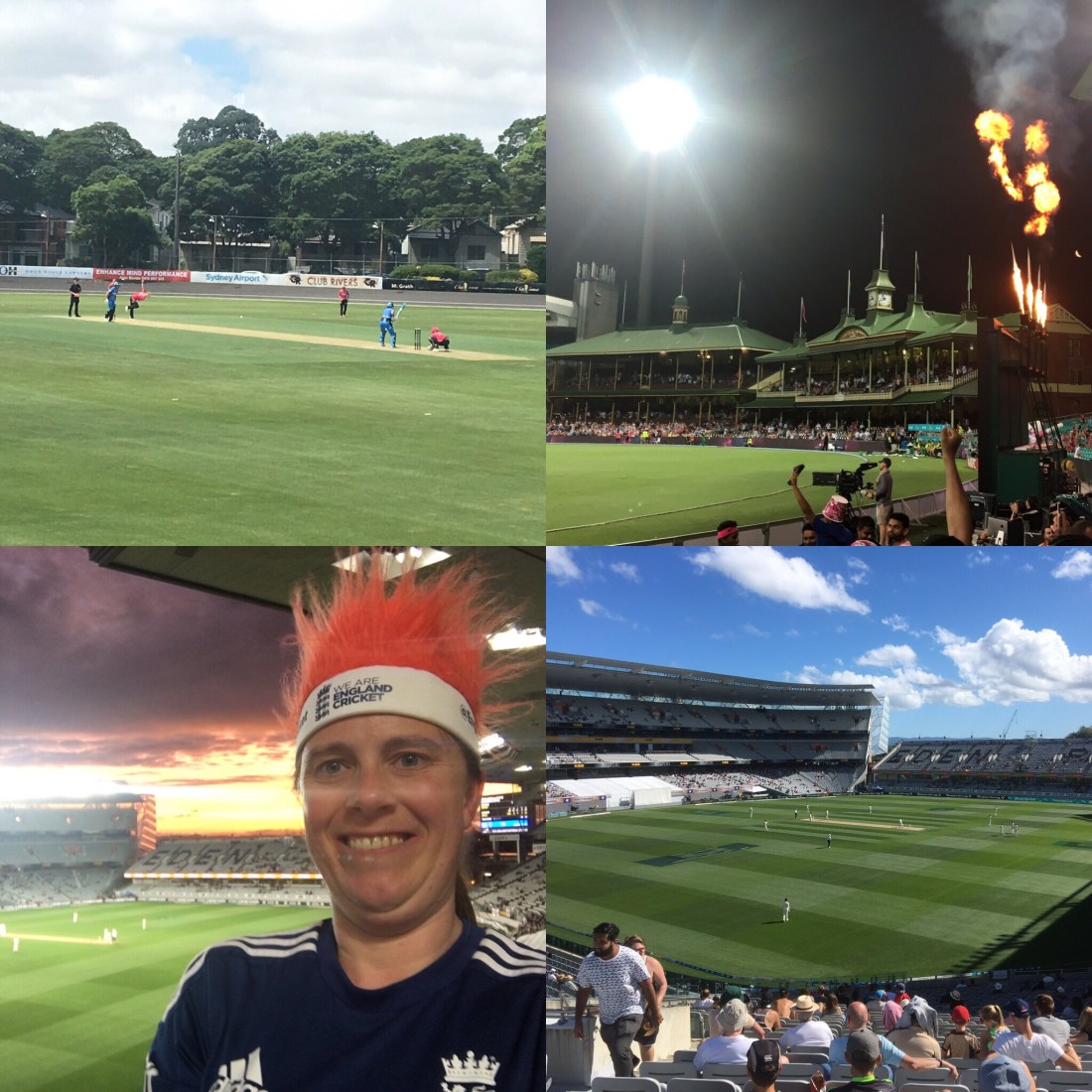
I went to five games: three at the SCG (a men’s/women’s Sydney derby double header and a Sixers men’s standalone game), a men’s game in Melbourne and a women’s match in Hurstville, to the south of Sydney. I accept that the crowd experience may not be everyone’s cup of tea, and some of it isn’t mine, but the music between every ball, lots of replays on the big screen, organised chants and colourful freebies (especially the KFC bucket hats) help to appeal to an audience that may not otherwise watch cricket, especially youngsters. Although there’s plenty of beer on sale and long queues to buy it, the family-friendly, or indeed family-targeted, nature of the Bash is what sets it apart from the T20 Blast, which I’ve been to many times at at the Oval and has (at that venue at least) long since become full of city boys on the lash, with the cricket merely a sideshow. The best atmosphere was arguably at the women’s game, where there were 1,000 spectators, free entry, free hot dogs and cheap beer, great big screen and sound system, and a competitive game won by an Alyssa Healy hundred. I’ll be back next year – including at the games at North Sydney Oval, which is a hop, step and jump from my new home.

In the men’s tournament, neither Sydney side covered itself in glory – though the star-studded Sixers woke up once they were out of contention for the semis, so I jumped on the bandwagon of the Hobart Hurricanes, the plucky underdogs at the start who were inspired by the characterful Anglo-Caribbean Joffra Archer and one of my favourite Australian players George Bailey into a stunning run and ended up runners-up. Timing definitely benefits the BBL too – finishing shortly before the IPL it acts as a bit of a shop window and attracts most top players. That said, it was pleasing to see the likes of Joe Denly perform when selected as late replacements. One of the few things I’d change if I were in change is stop the women’s semis and final needing to be back-to-back with the men’s: allow the top teams the home advantage like the men have and let the games be played in sold-out smaller grounds rather than empty stadia. The WBBL is established enough now that it can stand alone.

The eight-team format means that all the major cities (sorry Canberra and Darwin) have a team, and the two biggest have two. It works because such a high proportion of people live in or near these cities. In England, the picking of 8 teams for the new tournament is bound to be divisive because the population is so much more spread and it remains to be see how well people get behind the new teams. Another thing I’ve seen more of in the BBL this year than before is taking games elsewhere, such as Geelong and Launceston, which has led to sell-out crowds and wider engagement in the regions. The English tournament and its teams need to take note of this.

Right, enough of the short stuff, onto the Eden Park test. Clearly for England not the result desired, despite at least a bit of fight being shown today. Despite the batting being the laughing stock on day one, it’s actually our bowling I’m more worried about – just can’t see how we’re going to bowl decent sides out twice. Eden Park isn’t a pretty stadium, will always feel like a rugby ground with a cricket pitch in it, and is really too big for test matches in NZ in my view, given crowd sizes. That said, I enjoyed watching there. You can get a great view behind the bowler’s arm in the shade in the north stand very cheaply (a four-day pass was $90, less than what I paid for almost every individual day at the Ashes), transport is easy as the rail station is just across to road along with a row of food options for lunch beforehand, there was good beer to be had if you can be bothered walking down to the food vans on the outer oval, and the crowd was friendly, knowledgeable and passionate. The noise as the game reached its climax this evening was immense and belied the numbers present, but this was due to fans excited about a fantastic performance and result (national pride here is huge) rather than an excess of the sauce. As we waited for the train home, there was none of the booze behaviour I’d expect after a day of test cricket back home, especially at night and when the home team won.

Onwards to Christchurch, which will be a very different experience – a small ground in a park with big grassy banks, made into an international venue after the 2010 and 2011 earthquakes. It sounds delightful, and given my connection to the city (I lived there for a year in 2006-7) I’m very excited about it. I hope the England team can raise its game!

Buses, bikes and hire cars

Yes, yes – it’s a second transport post so soon after the first. I know, I know… but now I have a home and a commute and a routine, I have more to say!

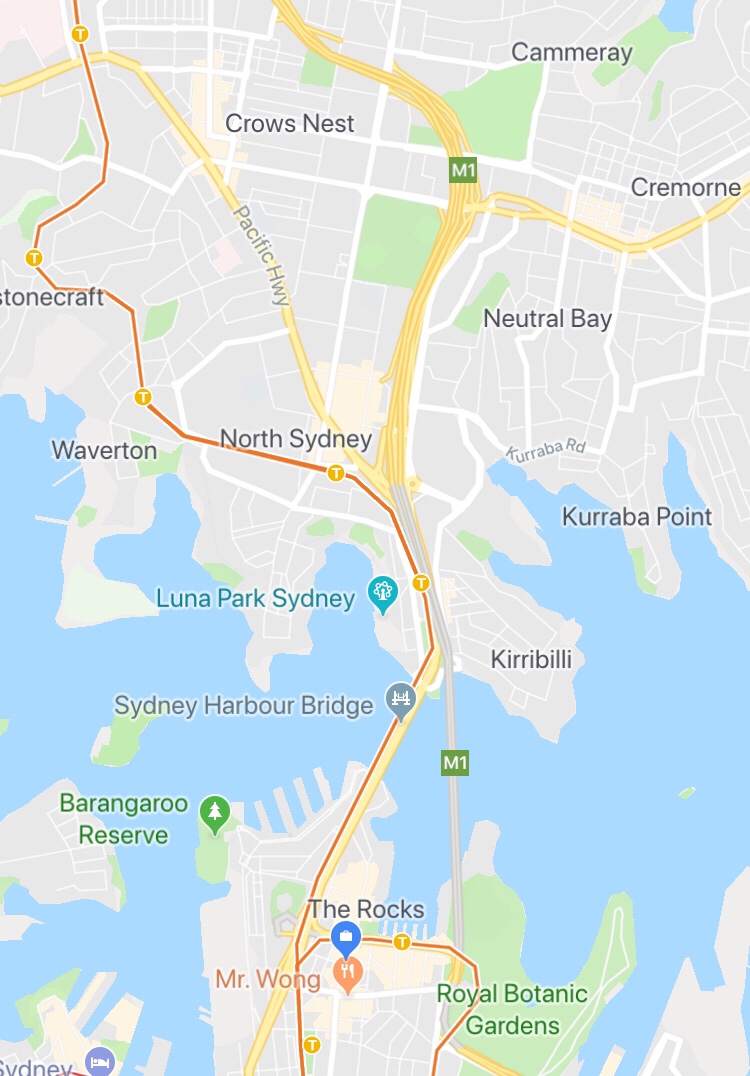
The three modes in the title sum up the way I’ve been getting around lately. My commute is a bus or a bike, and my aim is to cycle more often than I don’t. The journey time is much of a muchness – about 25 minutes, but I need and appreciate the exercise, and if I go via the wonderful swimming pool at Milson’s Point then the bike is definitely quicker. It’s quite different from my London commute though, and not only because it’s not much more than half the distance.

Half the journey – crossing the Harbour Bridge – is utterly glorious, once I’ve hauled my bike up the steps onto the cycleway. I hadn’t realised until I moved north of the bridge that you can only walk over the East side (the glamorous view side), and the West side is a dedicated bike path. After leaving the path on the southern side, I can roll along a quiet street in The Rocks and down a hair-raisingly steep but thankfully short street and I’m at the office. Winner. The northern end is less amazing – not awful, but mostly a road with a fair few cars, not all of whose drivers are all that considerate. I recently discovered a cut-through which chops some of it off on the way down, which helps, but the ride will never fill me with deep joy, especially on the way home when I can’t do the cut-through because of a 100m one way stretch, and it’s uphill all the way. I’m glad though that I work at the north of the CBD and travel north to get home, avoiding the need to ride through the long-and-thin city centre very often.

What I realised while wheeling over the bridge to work one day last week is that I’ve hardly overtaken anyone on my bike since arriving. Now, there is no doubt I am woefully out of shape right now, but my conclusion to both this and the tragic underuse of work’s amazing bike facility is that cycling just isn’t seen as a mode of transport. I’ve seen a fair few Lycra-clad blokes on road bikes, but not many work clothes-wearing folk using their hybrid to get to to the office. As those who I’m friends with on Facebook will have seen, I posted a photo last Friday of the cycle storage room at 8.30am that day. There were a single figure number of bikes in an office of 3,000 people. Maybe a quarter of the number there would be on a typical day at my London employer, where the office held 200. It’s certainly a combination of factors, but I reckon a joined-up strategy to improve the very mixed infrastructure and improve awareness would be money well spent. That said, it appears there are some great off-road bike paths around the edges of the city – in Centennial Park and around the north shore – so I need to check those out at a weekend.

On days when I’m not on the bike, I commute by bus. My nearest station is in North Sydney, 20 minutes’ walk away, so by the time I got there I could be most of the way to the office, so it’s only worth it if I need to do or buy something there on the way/way home. There’s a bus stop within 30 metres of my front door, but turns out that buses don’t run through to the city from there in the high morning peak, so I need to stroll about 8 minutes north, over the freeway to Cammeray, from where buses run extremely frequently and get straight onto the freeway. It isn’t free-flowing, but buses rarely come to a halt, and I’m still in the novelty period when I enjoy going over the harbour bridge and looking at the view. I love the orderly queues at bus stops, and in Cammeray there are two queues on opposite sides of the pavement – one for the city and another for North Sydney. Some days I’ve had to wait for a couple of buses to go by, and on other days it’s been empty at the stop and on the bus – I can’t work it out! But the post-late-night-in-the-office journey home in a taxi last Tuesday night made me realise how long it “should” take to get home from the CBD – not much more than five minutes!

The other way I’ve got around a little bit is in a “Goget”, the Australian equivalent of zipcar. I’ve been seriously impressed with this operation – heaps of cars (three cars and a van within five minutes’ walk of my place), a choice of membership packages, and real ease of use – book on an app, scan your card on a reader on the windscreen to open the car and off you go. I hired one for a few hours the day I moved house, and again to pick up a Facebook marketplace purchase two days later, and for a third time this Saturday as I needed to be in a slightly obscure bit of the Central Coast by 9am to go kayaking, and thought I’d do an all-day booking so I could hit the homewares shops on my way home. It feels like a big marginal cost per use, but at under $10 an hour or $80 per day (plus a per-mile cost, which doesn’t apply under 150km on an all-day booking, tolls and $12/month membership), it’s a damn sight cheaper and less hassle than owning a car Incidentally, Patonga is lovely and the kayaking was great!

All in all, I miss London cycle infrastructure, but can’t say I miss the crowded 07:57 from Tulse Hill to Blackfriars! My bus commute is a lot cheaper too…

Relocation, relocation, relocation

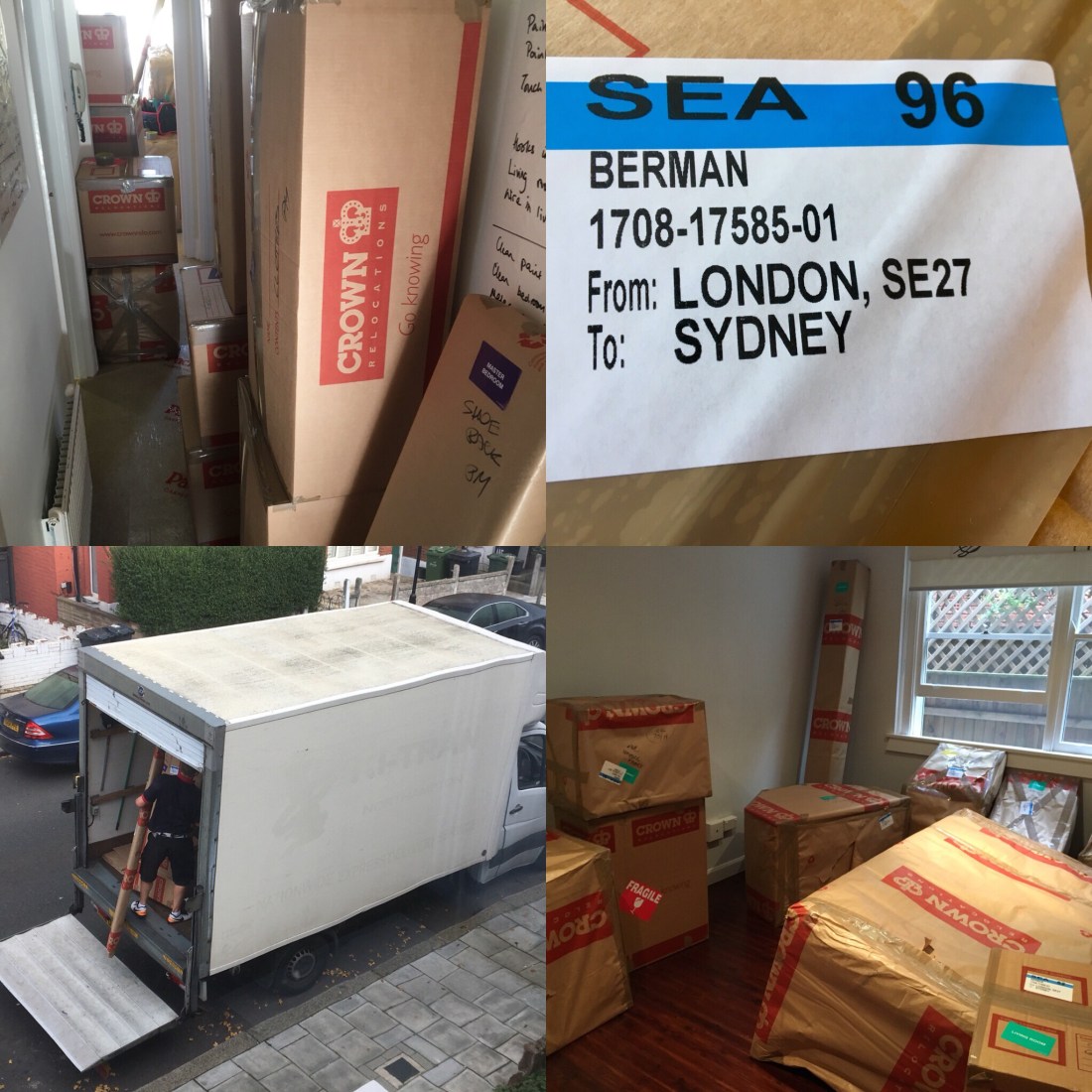
It’s been an exciting week! On Saturday I picked up the keys to my new apartment and on Monday my 97-box consignment from London was delivered. After three and a half months of being a nomad, I can’t overstate how amazing it felt on Monday evening to cook dinner with my own pans and then sleep in my own bed!

The “journey” began in September, when I got quotations from three relocation companies to ship my possessions around the world. By this point I knew I had a generous relocation allowance from my employer, so I decided to ship rather than rent my flat out furnished and buy everything again. I had some handy advice from two sets of friends who had made the move before me, and approached the companies they had used (respectively Crown and PSS , who are the two market leaders) plus one other. The prices varied hugely, largely due to estimated volume: the third company, who did a video survey rather than coming in person, thought I had vastly more stuff than the other two and would therefore only price on the basis of a whole container rather than sharing one. As well as additional cost, this would have meant a faster shipping time, which I didn’t want given my holiday plans. So that was one company down. Between the other two, I picked Crown, who were more expensive but not by a lot, especially after I haggled with them to get some free storage. I liked the sound of their service, including the fact that they operate in Australia themselves rather than contracting the delivery out to another agent as PSS do.

Crown did pretty much all the packing for me, other than I did fill the suitcases, holdalls and plastic storage boxes that I wanted to bring over. So the big job in advance of them showing up was sorting my stuff into three categories: container, suitcases coming with me, and bin/give away.

I tried to be ruthless with my decision-making, knowing that every additional cubic foot would cost me around £6. So books were no problem – incremental cost of each one was pennies – but I decided against an ageing wardrobe and bookcase that I’d got second hand and never really liked, my second sofa and a chest of drawers that was starting to look tatty. Food of any sort and things may of wicker or untreated wood were not allowed and alcohol not worth it due to obnoxiously high duty prices, so parents and friends got a few gifts, and I’ve stored a few of the bottles of better booze at my parents’. Beyond that, and three boxes that my friend Claire is kindly keeping in her loft, I’ve stored nothing back in the UK: I was determined to avoid a self-storage unit, as it would just become a money sink if I stayed here long term. There were a few tedious requirements, like making sure no soil on anything, so my friend Yvann and I had “fun” disinfecting the soles of all of my shoes and various other things.

I booked the packing and removal over a day and a bit, starting the day after my work leaving drinks. Probably an error, frankly – adrenaline just about got me through the day, but when the shipping guys left about 3pm, the emotion of it all and my hangover combined to completely floor me, and I sat on the floor of my spare room and sobbed. I’m pleased to say that, to date, that’s the only time in the process that I’ve really asked myself “What have I done?!”

The packer guys were impressive – alarmingly efficient, but also used their brains – for example, checking with me whether I really wanted them to pack my window keys! That said, I’ve just unpacked a cardboard wine box, which I really didn’t need! Small items were wrapped, while large ones were wrapped up in brown paper as they were, though they did dismantle my bed and desk. Every item had a sticker for the room, had contents written on it, and was stickered with a number and logged on a list of what’s what – mostly for customs purposes, so the inspectors can decide which ones to check out. Thankfully my stuff got through customs fine, which saves time and a lot of dollars, so glad I followed the rules!

I ended up with 97 stickered boxes or packets, all of which I then ticked off as they were brought into the flat on Monday morning. The Crown guys re-assembled the bed and desk, unwrapped furniture and put it where I wanted it, and unpacked the boxes I requested. So we had a production line going on the kitchenware, with one of the guys unpacking and me putting into cupboards, but I asked them to leave books etc. in boxes as I’ll need to buy more cases for them. As a result, my kitchen, bathroom and kitchen are pretty much sorted and the living room is getting there, but the spare room is full of boxes and mess. I’ll unpack what I can this weekend, but suspect it’s next stop Ikea!

But, most importantly, the place feels like home already, and did the day I moved in. Shipping my stuff was absolutely worth it.

It’s like the NHS, but not…

Given my track record, it was a matter of time before I ended up in a hospital emergency department, though I’d hoped to last rather longer than this! Before you start sending me concerned messages, I should assure you I’m basically fine, but I had a nasty fall on some iron-edged steps on Friday night and took a chunk out of my right knee. By Saturday morning, when it was still painful and a bit messy, I decided that maybe it needed some attention.  Not the most exciting way to spend a Saturday, but the silver lining was a new blog subject, so here goes with some initial observations on differences in the healthcare system.

There is no NHS here, but there is Medicare, which serves some of the same purpose. Unlike the NHS, Medicare doesn’t cover ambulance transport, some hospital service costs (e.g. you contribute to the cost of the bed and meals if you’re an in-patient) or dental or most optical treatment. In addition, if a doctor chooses to charge more than a fixed Medicare fee then you have to cover the difference (known as the “gap”). Some doctors “bulk bill” Medicare, but with others you need to pay and then claim the cost back. Both my currently-local hospital and the GP surgery I went to this morning for a check-up on the knee bulk-billed, but I had to hunt around for a CBD GP that did, and that didn’t charge a gap fee.

Getting a Medicare card was, in itself, a bit of a hassle. No issue with eligibility since I’m an Australian citizen (though there is a reciprocal healthcare arrangement with the UK so British people are eligible). The issue was more it not being at all clear online which of the “Medicare service centres” in Sydney would process registrations, and, once I actually knew where I needed to go, having to wait nearly 90 minutes to be seen despite arriving earlier than the place opened. But it was worthwhile getting it sorted so that all I had to do to get free treatment these last few days was wave my shiny new green card.

Private health insurance is fairly widespread over here, with two types of cover: hospital and “extras”. Hospital cover rather speaks for itself, covering ambulances, hospital service costs and private patient costs of many procedures. “Extras” cover all other  dental, optical (including glasses and contact lenses as well as eye tests), physiotherapy, remedial massage, psychiatric treatment, chiropractors and so on, but usually with annual limits and sometimes only a proportion of costs paid. I’ve taken this all out, but I’m still baulking at the cost and may change or cancel it during the 30-day cooling off period on my policy. There’s a scheme whereby, on a means-tested basis, people are eligible for a part-rebate on their Medicare levy (which is 2% of taxable income, taken out of salary) if they have private health insurance, presumably because they’d be more likely to opt for treatment funded by insurance and therefore claim less from Medicare. Interestingly, while private healthcare cover was a benefit I received from my UK employer, paying only the tax on the premium, this isn’t the case here even though I work for a much larger organisation.

Based on my limited experience so far, healthcare feels a lot more commercialised than in the UK, with GP surgeries more overtly being private businesses, and I’ve no doubt it will cost me a lot more than I’m used to. On the flip side, only yesterday I had my pick of appointment times today at several GPs and could book in online even without ever having been before or registered many details let alone needing to have any sort of introductory health check. Many surgeries are even open seven days a week. I was well looked after this morning too: the doctor took a look at my knee then ushered me off to what almost felt like a small hospital ward where a nurse immediately set to work sorting out my dressing.

My hospital experience was much the same as A&E back home: tedious. No issues at all with the medical care, but there was a lot of waiting around despite the place not feeling busy. I waited for triage (albeit quite briefly), to see the doctor, for a tetanus shot, for the porter to take me for an x-ray, for the x-ray itself, to be taken back by the same porter, and (for an hour and a half) for the x-ray results. A total of over three hours I will never get back.

I am sure there’s much more to say on this topic, but for the sake of my health, I hope I don’t experience it too soon!

A place to call my own

Two weeks of silence… but with good reason – the all-consuming process of flat hunting. It’s been in equal parts frustrating, exhausting and stressful, but I think has eventually has come to a good conclusion! I haven’t looked for a rental place in seven years and knew it wouldn’t be fun, but I wasn’t really prepared for the emotional rollercoaster.

The first step was deciding where to look, because all of Sydney, or all of Sydney within a sensible commute of work, was really too large an area to be able to cover! A classic place for British people to live is Bondi, but it just didn’t appeal. It might have done had I been 5 or 10 years younger. I’m currently temporarily in Darlinghurst, just south of the CBD. It’s great for many reasons, mostly it being walking distance from work and the fantastic bar and coffee scene, but it’s also a bit noisy (especially on a Saturday night!) and rather expensive – and I decided for the same money I’d rather have more space than trendiness on the doorstep! With family and family friends north and north west of the city, and the appeal of a harbour view every morning on the way to work, I settled on the north shore, a short bus or train ride across the harbour from the office. I spent a few days and evenings pottering about a few suburbs to narrow it down, deciding I liked Crows Nest best, especially the feel of the high street which was off rather than along the main highway, with lots of cafes, restaurant, bars and local shops. One of my biggest mistakes was not settling on that once and for all; instead trying to view across a wider area across to and including Neutral Bay, a couple of miles further east.

Working out what I can afford and was willing to spend wasn’t easy either. I know what the tax bands are and had been advised by friends about relative costs of utilities and so on (and experienced first-hand what seem like astronomical supermarket food prices!), but I haven’t had a pay packet yet, or even a month of normal expenditure, so there’s definitely some guesswork going into the “what can I afford?” question. I set out with an ambition of two bedrooms, to mirror my London arrangement of having a guest room/study, and realised pretty quickly that to achieve that in Crows Nest or anywhere else decent within a half-hour commute, I had to be prepared to part with at least $600 (350 pounds) per week. Suffice to say that’s a lot more than my London mortgage payments! But that was my starting point, but I wanted to see what that much or less could get me on a one-bed.

I’m told I’ve chosen the worst time of year to house hunt, and my experience is certainly that it’s a seller’s (landlord’s) market right now. Quite the opposite of how I found it in South London before Christmas when trying to let my flat out – another painful process with an eventual successful resolution! Back home, private viewings are the norm – the prospective renter usually arranges a time with the agent and is shown around on their own, and the existing tenants have to suck up potentially many viewings. Here, unless a property is vacant, and even in some cases when it is, it’s an open home approach with a very narrow window. A 15-minute time slot, usually on a Saturday morning but sometimes during the week, is advertised, and in that short time you can expect 10 or more other people or couples to be there with you and the agent. And then you scuttle off to the next one, and unless you take detailed notes, by the end of the day all the flats blend into one.

My Saturday viewing experience, a week ago, was deeply frustrating. It didn’t help that I was still holding out a little bit of hope for an utterly perfect place I had seen three days earlier (along with about 30 other people), offered well above asking price and not heard anything since. I tried to see too many properties over too wide a geographical area, taking three cabs between Crows Nest and Neutral Bay and missing a couple of viewing windows while waiting around and in transit. Turns out, if you’re 5 minutes late for a slot then no can do. Those I did see didn’t quite hit the mark, though some were close. All those under $600/week, whether one-bed or two, were in awkward locations or simply not very nice, but I came close to offering on one of a couple with a slightly higher price tag. Both were very new and ticked all the boxes in theory; one of them only had one bedroom, but in return I would have got a huge living room and balcony. One of them also had an incredible view over Sydney. But neither felt right; after my sometimes troublesome but beautifully characterful Victorian terrace conversion in London, I found the uber-modern very open-plan square box style quite soulless. And there wasn’t nearly enough kitchen surface space, which might have driven me spare.

It was an anxious couple of days that followed, as I berated myself for being so fussy, wondered whether I should crack and apply for one of them and got a bit stressy about what I’d do when I got kicked out of current place on the 10th. But glad I held out, because (via another viewing, application and rejection on Tuesday), I secured a Wednesday morning viewing on a flat I’d just failed to spot before Saturday and, by some miracle, wasn’t taken after the weekend’s viewings. It took me all of about 30 seconds to think “yes, this is it.” Larger and cheaper than both of the two I’d ummed and ahhed about over the weekend, and than the latest place that didn’t want me, older (which I prefer, and will suit my furniture better) but with a modern kitchen and bathroom, and in a block of only four. I was desperate not to let this become rejection number three.

Statistically, I should have expected to get turned down at least a couple of times, given the number of people at almost all the viewings. And not having an Australian rental history or any form of landlord reference may have put me in the “too complicated” bracket in the eyes of a landlord faced with his or her pick of professional applicants. But the lack of feedback really cheesed me off. I work in a business where we have to bid competitively for most of our work, it takes a lot of time and effort, but at least if you’re not successful you at least get some indication of why not. Applying for a flat – no way. I tried, and was given nothing: “We had several applications and the landlord had to choose one of them. There was nothing wrong with yours.” Gah!

One good thing about the Aussie system, or the Sydney one at least, is that applications with most agents are done via the same online form which you can store your details and scanned ID copies on. Hence, a little scarred by the rejections and having seen about 15 other people at this latest viewing, I did my application on the bus back to work, and texted the agent (with whom I’d already done the full charm offensive) to say if I needed to offer more money then I’d be happy to consider it. 24 hours later, I was told it was mine at asking price, if I paid a week’s rent within another 24 hours. Phew.

So, I move in on the 17th (via a week of sofa surfing with friends and family) and my stuff shipped from the UK will arrive on the 19th. It’s all falling into place.

Trains, planes and automobiles

It was a matter of time before I wrote a transport post, and I’m sure there will be more to come. But here are some initial observations on how people get around over here, and how the experience differs from back home.

Trains

Trains in and around Sydney are operated, by the imaginatively-named Sydney Trains, a division of Transport for New South Wales. Most transport in Australia is controlled at the state level and the modus operandi varies – for example both the trains and trams in Melbourne are privately run on a franchised basis similar to in the UK. But enough of that – I’m just getting my work brain going after my first week!

The Sydney rail network isn’t nearly as wide as the London tube or suburban rail (it has 178 stations) due, I’m sure, to much lower population density. A lot of investment has recently been committed though, including a new metro service to the north west and, later, the south west, and various light rail lines. But there are huge areas of commuterville which are, and will remain, nowhere near a rail service. Nationwide, there is no material passenger service other than around Sydney and Melbourne, though you can also (infrequently) get between them and to Canberra and Brisbane, and on tourist-focussed weekly services between Adelaide and Darwin and between Sydney and Perth. To illustrate this, turn on the public transport layer on Google Maps and zoom out until all of Australia is on screen. There aren’t many lines on the map!

In Sydney and around, most of the trains themselves are ugly on the outside but comfy on the inside (the one in the photo is one of the newer and more attractive sets) and, and this always seems to amaze many Britons, double-decker, with a mezzanine level where you get on and off. It’s weird to sit on the bottom deck and be below platform level! The direction of the seats is reversible, so you can choose to sit in a group of four, or not, and to always face forward if you wish. The regional services aren’t speedy (a 54km journey last week took an hour) but they are cheap outside the peak (the same journey cost a remarkable $4.60). I must add though, that I then had to take three buses to get a further 30km to my cousin’s house, making a total of three hours travelling, when in a car it would have taken just over an hour end-to-end. And I had a battle with a rail replacement bus in amongst that too.

The hub of Sydney’s rail network is Central station, which is of mammoth size – 27 platforms – but isn’t really in the centre of the city, though many trains do serve the CBD further north too. According to Wikipedia, annual patronage at Central is about 11 million, compared to nearly 100 million at London Waterloo. Even if like isn’t quite being compared with like in terms of the data, that’s quite a difference!

Sydney, Melbourne and Auckland all have their equivalents of London’s Oyster card: Opal, Myki and AT Hop respectively. They work very much like Oyster does, though you need to tap off as well as onto buses, which takes some getting used to (and I paid an idiot tax when I forgot in Auckland!). The Opal offers a $2 discount for journeys involving more than one mode, and once eight journeys have been made in a week, the remaining ones that week are half-price. The other great thing about Opal is it’s not constrained to the Sydney urban area but works throughout NSW, unlike Oyster where it can be annoying to realise you’ve touched on but where you’re going is outside the Oyster zone.

Planes

Air is the main way to get between cities here, given the distance between them. It’s also surprisingly popular in NZ , where distances are much smaller. Sydney to Melbourne takes 90 minutes in the air and there are over 50 per day. On popular routes like this, there’s strong competition between four airlines (Qantas, Jetstar, Virgin, Tiger), meaning there’s usually an opportunity to bag a pretty low fare.

I took three internal flights with Jetstar and Virgin on my trip, and am writing this from Sydney airport as I’m about to board a Tiger plane. Jetstar I see as the equivalent of easyJet, while Virgin gives you tea and a checked-in bag in the base fare. Qantas gave me lunch and a glass of wine on a trans-Tasman flight, but then I took AirNZ back to Melbourne and failed to remember that food wasn’t in their basic package. I succumbed to an overpriced toasted sandwich as I wasn’t going to last three and a half hours without!

Common to all my domestic flights was a very different (and more relaxed) approach to security than I’m used to. Pleasingly, there’s no liquids restriction on domestic flights, so I didn’t have to faff with clear plastic bags and burying my toothpaste in my checked bag. More surprisingly, at no stage of the process on any of the three domestic flights did anyone ask for me to identify myself. I could have sold the ticket to anyone (probably anyone female, realistically)! Non-passengers can go to the gate if they are prepared to have their bags x-rayed, and you can walk in off the street to the baggage carousel. I always wonder how common baggage theft is, but have never heard of it being an issue.

Automobiles

I don’t know the stats, but it feels like car ownership is high here, and certainly higher in Sydney than London. After three years car-free, I think I’m as likely as not to buy one before very long, even though I’ll live quite centrally. Motorways and multi-lane highways run very close to and through the city, tolls are widespread, and peak hour traffic is hideous. I have no idea where these people park near their offices!

Driving itself isn’t far removed from the experience back home, though there are some subtle differences. There are more larger cars and more automatic cars – good luck if you want to hire a manual! But the biggest differences I’ve noticed is that there’s no obligation on dual carriageways to keep left unless overtaking, and so passing on the left is commonplace, and cars with a green light to turn have to give way to pedestrians crossing the road they are turning into, who will have a green man on the crossing – so they turn part way and then wait by the crossing. These both take some getting used to, especially seeing a car turn towards you when you’re a pedestrian crossing on a green man.

A note on the rest

Sydney appears to have a pretty good bus network. I’ve only really used the buses to get to and from my cousin’s place in Castle Hill, but they’ve been frequent and reliable, even in the peak. The express buses to the city run on the motorway where there are dedicated bus lanes and a couple of stops in the central reservation accessed via bridges. I haven’t experienced the inner city buses in the peak yet, but that may end up being how I commute. Ferry is another commuting option, depending on where I live. It’s pricier than the bus or train, but there’s something very pleasant-seeming about getting to work that way. The ferry network operates from Circular Quay, which is about five minutes from the office and is also served by a rail station.

In Melbourne, tram is the main way to get around, and around the CBD there’s a zone where journeys are free, which is great for tourists like me, though I do wonder how many trips would otherwise be made on foot.

The hard work starts tomorrow

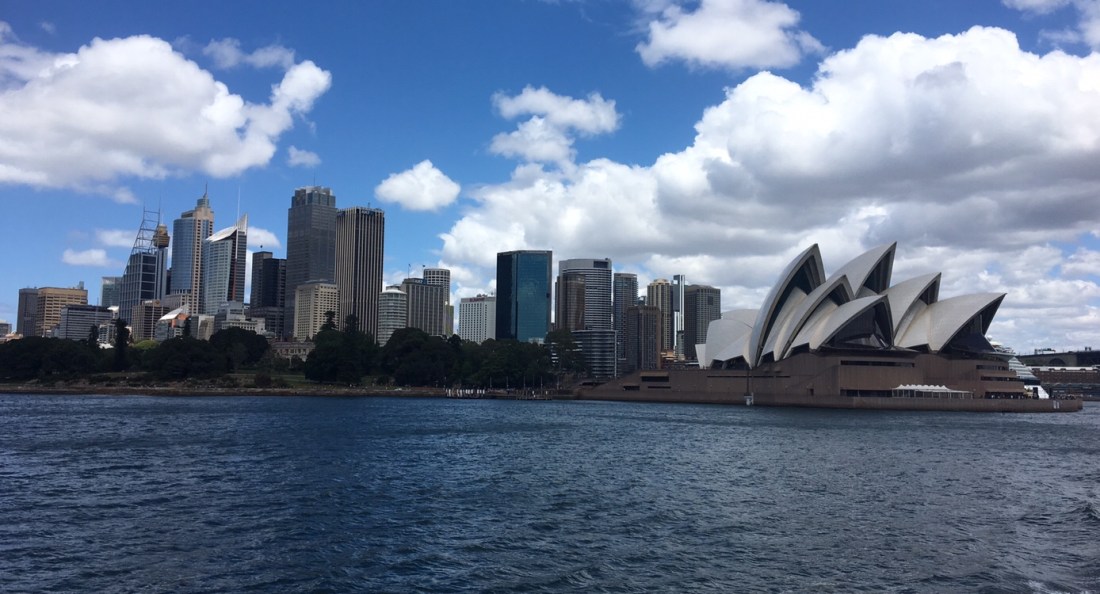
My word, 11 weeks have gone quickly! But tomorrow, 80 days after leaving my job in London and 55 days after leaving the UK, I finally start my new job in the EY building you can see in the photo (to the right of the squarish turquoise one). Nice location, huh?

I’m feeling a mixture of excitement, apprehension and disbelief! Moving here hasn’t really felt real throughout the whole process, and I still don’t think I’ve processed the idea of going to work in a new place, or indeed going to work at all after getting so used to being on holiday! But I’m very happy not to be living out of a suitcase any more (I’ve moved into an Airbnb flat for 4 weeks), a routine will be good, my body will be thankful for fewer calories and units of alcohol and my bank balance for a salary.

I’m sure I’ll get into the swing of things, but I’ll need to turn the brain on to learn about new market, new colleagues, new company… must keep telling myself a new challenge is a good thing!

The Ashes – the last rites

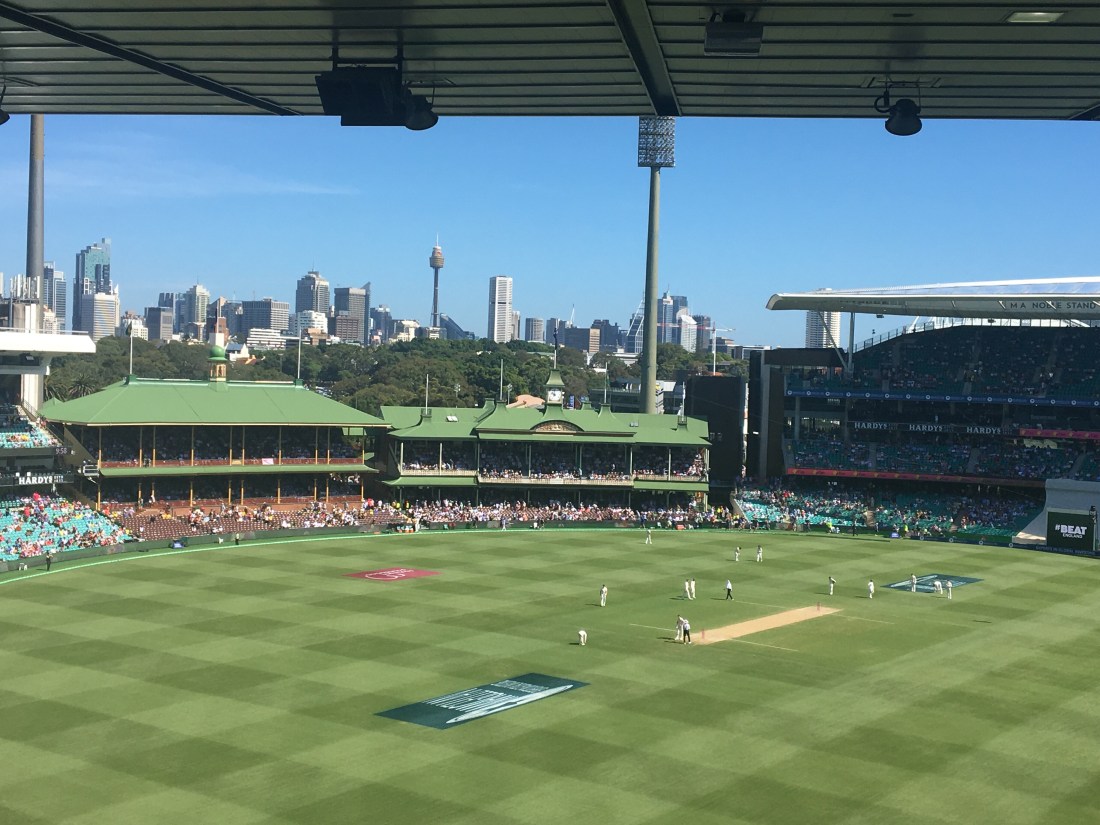
So that’s that then. England outgunned and outclassed, and defeated 4-0. I’ll leave the post-mortem to the many excellent cricket journalists of the world (Mike Atherton being my personal favourite – you can read many of his Ashes columns without the Times paywall on The Australian website), but I had to share the fabulous photo from my seat close to the back of the Victor Trumper stand!

I went to Days 2, 3 and 5. The former two I had tickets for thanks to my cousin, had family days out with her, her husband and my aunt / her mum, and enjoyed superb (if very expensive) seats up high behind the bowler’s arm. And, critically given the recent heatwave, in the shade all day. I enjoyed being there for Jane McGrath day, where spectators are encouraged to wear pink and donate to the breast cancer charity set up in memory of the late wife of the great Australian bowler, Glenn. The sight of swathes of the ground wearing pink (and the commentary teams in hideous pink suits) was quite a spectacle, some advertisers had special pink boards, and the Ladies’ Pavilion was renamed the Jane McGrath pavilion with a bright pink sign. Most importantly, over $1.3 million was raised during the game for a cause close to my heart.

I skipped Day 4 on the basis that the match position, weather forecast (43 degrees!!) and ticket price ($149 for a seat in the shade) and distance I was staying from central Sydney didn’t add up. But Day 5 was a case of “why not?”. I had a day with no concrete plans, admission was by “gold coin donation” ($1/$2) to sit anywhere, a recently-made friend was going, and, having seen ten of the previous 24 days of the series, it felt apt to be there for the last rites. England lasted well past lunch, which beat my expectations, and I had a very pleasant half day chatting with a backdrop of cricket. And ten minutes after close of play they let us onto the pitch, which was rather fun too.

I’ve been to the SCG before, but not not for eleven years. Glenn McGrath is clearly biased when he says it’s the best ground in the world, but I can see the case. It’s a big stadium – capacity of around 50,000 after its most recent redevelopment – but retains a far more traditional cricket ground feel than Melbourne, especially as the old pavilion has been left largely unchanged. And that view is hard to beat…

Resolutions for a new year and new country

A few days late, I know, but happy new year! I saw in 2018 in a park in Melbourne and enjoyed the very impressive fireworks set off from rooftops in the CBD. A bit weird to do so on my own (well, with hundreds of others around, but nobody I knew…) but perhaps an apt end to a year when I remembered how to make time and decisions for myself and enjoy my own company.

The new year means my extended holiday is drawing to a close, and it’s time to turn my mind to a new job and – as some of my friends have put it – a new life. I’m not sure I’d express it that way because I don’t intend to let go of a lot of the things I enjoyed in my “old life”, but settling in a new place and being over 10,000 miles from my closest family and most of my friends does mean a certain amount of beginning again. And the period of time off has given me a chance to think about what I want from that. So, despite the fact that I’m not normally one for resolutions, here are mine for the new year and “new life”:

1. Make time for myself

This is first, front and centre of my resolutions. Back home, I led a pretty manic life – working pretty hard (at various times, too hard), maintaining a very active social life and being a bit of a sucker for committees and responsibility. I can’t (and don’t want to) change my nature and of course I want to make friends in a new place, but the opportunity to do just a little bit less and have a few more evenings and weekend days to myself is one I know I need to take. Work is where that will be particularly challenging, since I know my instinct will be to prove myself in a new company, and work as hard as it takes to do that as soon as possible.

2. Get some exercise!

Despite quite a lot of walking, there’s no escaping the fact that an 11-week holiday isn’t a ticket to a healthy lifestyle unless you’re FAR more disciplined than I am! But, to be honest, the damage to my previous exercise regime (such as it was) was done before I left London. It turns out that announcing you’re leaving the country makes you quite in-demand for social occasions and (see 1 above) I don’t really need an excuse to rack these up. Cue many, many evenings out on the beer which, not only led to high-calorie food and drink consumption but also kiboshed my three-to-four times per week cycling to work habit. No wonder many of my clothes no longer fit. My bike will arrive in Sydney in mid-February, but I’ve resolved to get back into running (slow jogging) and sign up for a local parkrun. Two 5k-ish runs down and I’ve been shattered both times, but I remember it gets better…

3. Reduce consumption of single-use plastic stuff

This one isn’t for me, but plastic waste is something I feel quite strongly about without always putting my money where my mouth is. However, recently I’ve imposed a “no disposable coffee cup” rule on myself – if I forget my keep cup and won’t drink in, I don’t deserve the coffee, and if a coffee shop or stand won’t take/use it then they don’t deserve my money. Once it’s became routine to toss the keep cup in my handbag (I have had a lot of flat whites in the last 11 weeks), it’s not been hard – and it helps that proffering a cup when ordering a coffee is much more normal here than back home. I compare my experience at the very busy coffee stands at the Adelaide Oval and MCG here to that at the Ageas Bowl in Southampton, where the grumpy vendor (I refuse to call him a barista – the coffee was terrible) looked at me like I had three heads when I asked him to put my drink in my cup.

The challenge now is to always remember the reusable shopping bags, ignore the plastic veg bags in the supermarket, refuse straws and get hold of some beeswax wraps so I can remove cling film from my life. Plastic bags are still free here and therefore pretty widespread, but the two biggest supermarket chains are phasing them out by June this year.

4. Don’t spend NYE 2018-2019 alone!

Much as it was fun and I have zero regrets about doing the solo new year’s, some company would have been pleasant. Despite resolving to make time for myself in 2018, I’d like to make some new friends too!

Food, glorious food!

I can’t come to the foodie paradise that is Melbourne without writing a blog post about food and eating out!

A few weeks ago, a friend asked me what the best meal was I’d had all trip. I ummed and ahhed and could only think of one worthy of consideration. I hadn’t eaten badly, indeed I’d say well, but nothing had really wowed me. Now, things have changed, not only because I’ve spent the last few days in Melbourne, but it helps! After four days at the MCG, today I wandered into town from North Fitzroy and back again and passed hundreds of places that made my mouth water!

Eating out here has a couple of differences from back home. It’s a more efficient experience, because (other than in the poshest joints) it’s normal to pay at the bar or a cashier rather than waiting for the bill. In cafés, ordering at the bar is also much more common than in the UK, especially in NZ, though restaurants all offer table service. Secondly, there’s no compunction to tip and it’s unusual to have service charges added on. Living in London, I got used to 12.5% service charges, which made meals a lot more expensive than the menu suggested, so I find this amazingly refreshing! In NZ, some places charge a public holiday surcharge to cover their additional staff costs, and I’ve seen it on Sundays in a few places, but I’m yet to spot either it in Aus. Tipping is reserved for exceptional service rather than the norm, a model I much prefer to the UK (where I’ve only refused to pay it when service has been awful) or, worse, the US tipping culture.

In chronological order, these are my seven favourite meals on my trip so far…

The Rockpool Café, Stokes Bay, Kangaroo Island.

This was the one that was winning when my friend posed the question. The food – a seafood platter with chips and a flat white – were excellent, but probably not in the culinary league of the later entrants. But the waterfront setting, it coming straight after a delightful swim in the sea, and the fact I’d frugally solely eaten meals cooked in the back of my campervan for the preceding three days, made this meal memorable.

Campervan leftover omelette, Kangaroo Island

I was particularly smug about this gas stove creation, which I enjoyed in a seafront campsite in Penneshaw, Kangaroo Island, at the end of a wonderful few days of total freedom. It wasn’t fancy, but made perfect use of all my leftovers – eggs, tomatoes, ham and two granary tortilla wraps, which I lightly toasted and managed wedge the omelette between (no mean feat in the dark!). All washed down with a couple of glasses of Wirra Wirra Shiraz bought at the cellar door in McLaren Vale. Somehow this summed up my little campervan trip.

Depot, Auckland, New Zealand

If I were ranking these meals by deliciousness, this one would probably be at the top. A menu of small plates and large plates designed for sharing was perfect for me and a friend, both of whom enjoy variety and flavour. Everything was incredible, but the winner definitely hapuka belly with eggplant kasundi. The waiter made the mistake of telling us we could order extra kasundi, so of course we did, and noshed it all. We also loved sitting at the bar and getting recommendations from the bar staff. My only regret is being too full to order pudding, though the espresso/short black I had in lieu was excellent. I’ll be back.

Hone’s Garden, Russell, New Zealand

This excellent spot provided lunch on the middle day of three in the beautiful Bay of Islands. My aunt and uncle report that when they were last here, several years ago, it was a ramshackle garden bar where a small BBQ was fired up if food was ordered. Now it’s smartened up rather, with comfy seats, a craft beer bar and excellent pizzas. The only low point of our meal there was me chucking a glass of beer everywhere, including on my aunt’s skirt, but I can’t blame Hone for that!

Grain Store, Melbourne

This was excellent Melbourne breakfast venue number 1, and is where the photo above was taken. I decided to go there before play on Day Four of the test match on the basis of a number of online recommendations, and the fact they had a sweetcorn fritter on the menu. I’m a sucker for a good sweetcorn fritter, and thankfully this one was definitely up to standard! I didn’t need to eat at the cricket until well into the afternoon session.

Supernormal, Melbourne

A close-run second on the deliciousness ranking, and discovered entirely by accident. After the cricket ended yesterday, I hoped to have a quick dinner at my previously-favourite Melbourne eatery, Chin Chin. The queue was out of the door and round the corner (at 6pm! Seriously, that’s how good it is!) so I took to Google to find the nearest Asian restaurant. The result was Supernormal, a Japanese restaurant a block further east on Flinders Lane. It was heavier on my wallet than intended, but wow, it was sensational! All the savoury dishes – Kingfish sashimi, pork loin with wombok and chilli, and the best prawn and chicken dumplings I’ve ever eaten – were fabulous, and I enjoyed soaking up all the flavoursome sauce with rice. I didn’t need a dessert, but, once I saw peanut butter parfait with salted caramel and soft chocolate on the menu, there was no way I wasn’t having one. And that was another good decision! I loved sitting at the bar and watching the raw dishes being prepared – artists at work!

Babajan, Melbourne

My friend’s favourite local café in North Fitzroy, so it would have been rude not to give it a whirl. Another place where I could have happily eaten everything on the menu, but I opted for crab and halloumi omelette and wasn’t disappointed. And the coffee was excellent, and staff lovely.

Sydney is, so far, conspicuous by its absence, but only because I haven’t spent enough time there. I look forward to putting that right!